
How the WILAS IoT Command Centre Cuts Office Energy Waste
The largest controllable cost in an office is often the space itself, and much of it is running when no one is there. Lighting and air-conditioning stay on in empty meeting rooms and vacated zones because the building has no reliable signal for whether a space is occupied. Hybrid working has widened the gap between what is booked and what is used.
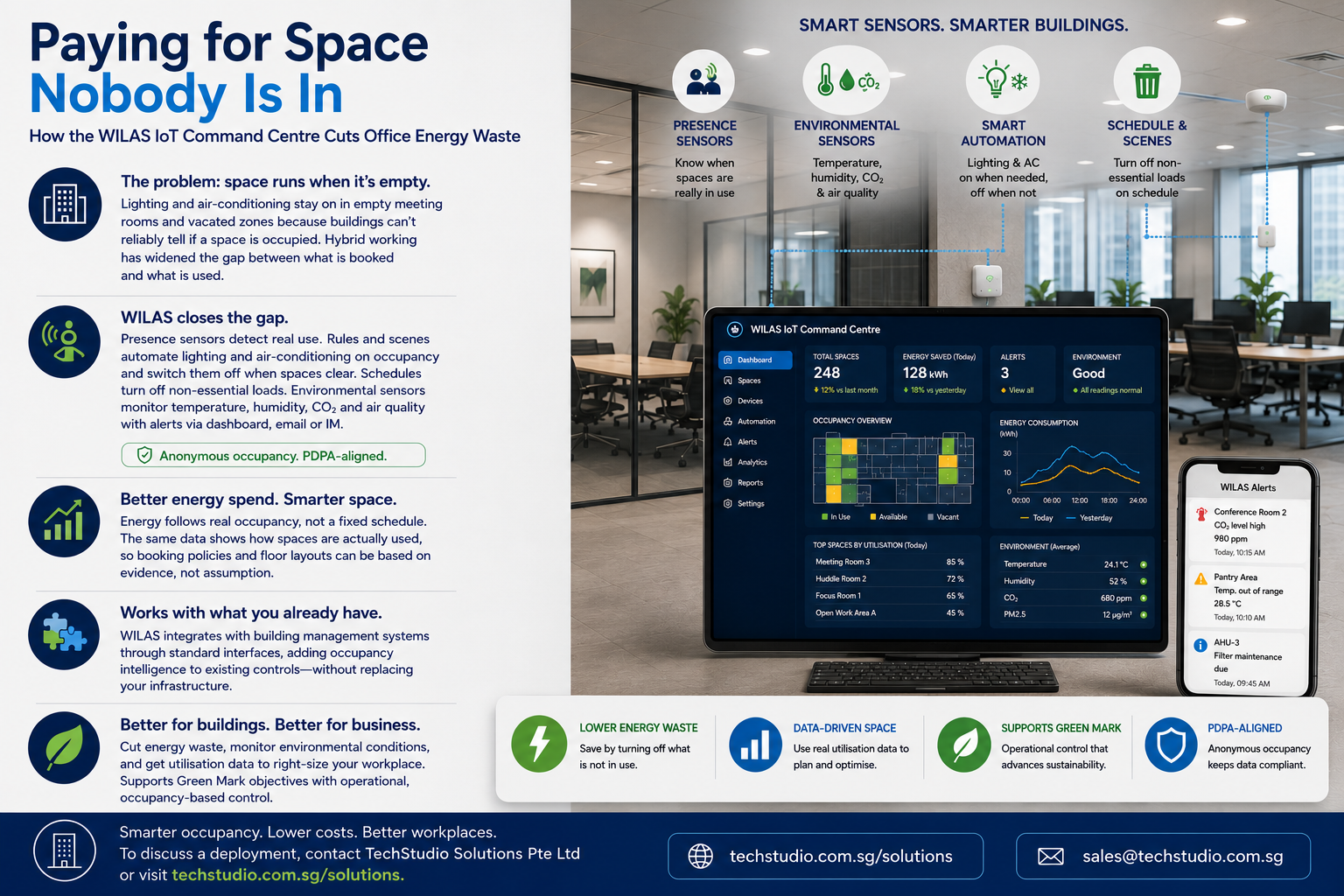
WILAS IoT Command Centre closes that gap with presence sensing and scheduling to enable automation. Presence sensors report whether a zone is genuinely in use. Rules and scenes act on that signal, bringing lighting and air-conditioning on when a zone is occupied and switching them off when it clears. Water dispenser and decoration lighting are off at the schedule instead of 24x7. Environmental sensors add temperature, humidity, CO2 and air-quality monitoring, with alerts by dashboard, email or Instant Message when a reading moves outside the set range. Presence is measured as anonymous occupancy rather than individual identity, keeping the platform aligned to the Personal Data Protection Act (PDPA).
For a facilities manager, two things improve at once. Energy spend follows real occupancy rather than a fixed schedule, and the same occupancy data becomes evidence for space planning. Booking policies can be checked against actual use, and floor layouts can be justified with data rather than assumption.
WILAS integrates with building management systems through standard interfaces, so it can add occupancy intelligence to controls a building already has rather than replacing them.
In a typical enterprise office, this means lower energy waste in unoccupied zones, a live view of environmental conditions, and utilisation data to right-size the workplace. It also supports Green Mark objectives by turning occupancy-based control into something operational. To discuss a deployment, contact TechStudio Solutions Pte Ltd or visit techstudio.com.sg/solutions.